The Bitcoin Holder's Dilemma: Yield vs Sovereignty in the Age of defi
tldr:
- Core Disconnect: Current DeFi solutions, often mirroring Ethereum's ecosystem, fundamentally misalign with the primary Bitcoin user base, which prioritizes security, self-custody, and long-term value preservation over complex, high-risk yield strategies.
- Untapped Opportunity: Despite Bitcoin's ~2 USD trillion market capitalization (as of May 2025), DeFi protocols specifically engaging BTC represent a minuscule fraction (e.g., Rootstock TVL ~180M USD, << 0.1% of BTC market cap), indicating a vast pool of dormant capital inaccessible via current non-native approaches (wrapping, complex staking).
- Path Forward: Sustainable growth requires shifting focus towards secure, native (or natively-interacting) Bitcoin applications that address tangible user needs, particularly robust, transparent lending/collateralization platforms offering tax-efficient liquidity (often sought as an alternative to CeFi rates of ~8-12%+), rather than replicating ETH DeFi models.
Any mistake is my mistake. This post do not necessarily reflect the thoughts of The Starknet Foundation.
Hypothesis
True Bitcoin holders, focused on long-term value storage and security, are unlikely to adopt solutions on less secure chains or rely heavily on complex wrapped/staked Bitcoin assets. They prioritize native Bitcoin.
Today's Focus: Understanding the Bitcoin holder mindset and why current DeFi solutions miss the mark. Insights from the TOKEN2049 BTC Summit and subsequent discussions confirm a crucial disconnect: the Bitcoin user base is not a monolith, and its priorities differ significantly from Ethereum's.
Attending the BTC Summit panels at TOKEN2049 highlighted this gap, particularly concerning making Bitcoin productive. The discussions revealed a potential misalignment with the core Bitcoin ethos – a challenge rooted not just in features, but in fundamentally different user psychologies and priorities.
Bitcoin Holder Segmentation: Preservationists, Global Users & TradFi Entrants
Understanding the target audience is crucial. We can broadly categorize the diverse Bitcoin landscape into three key segments:
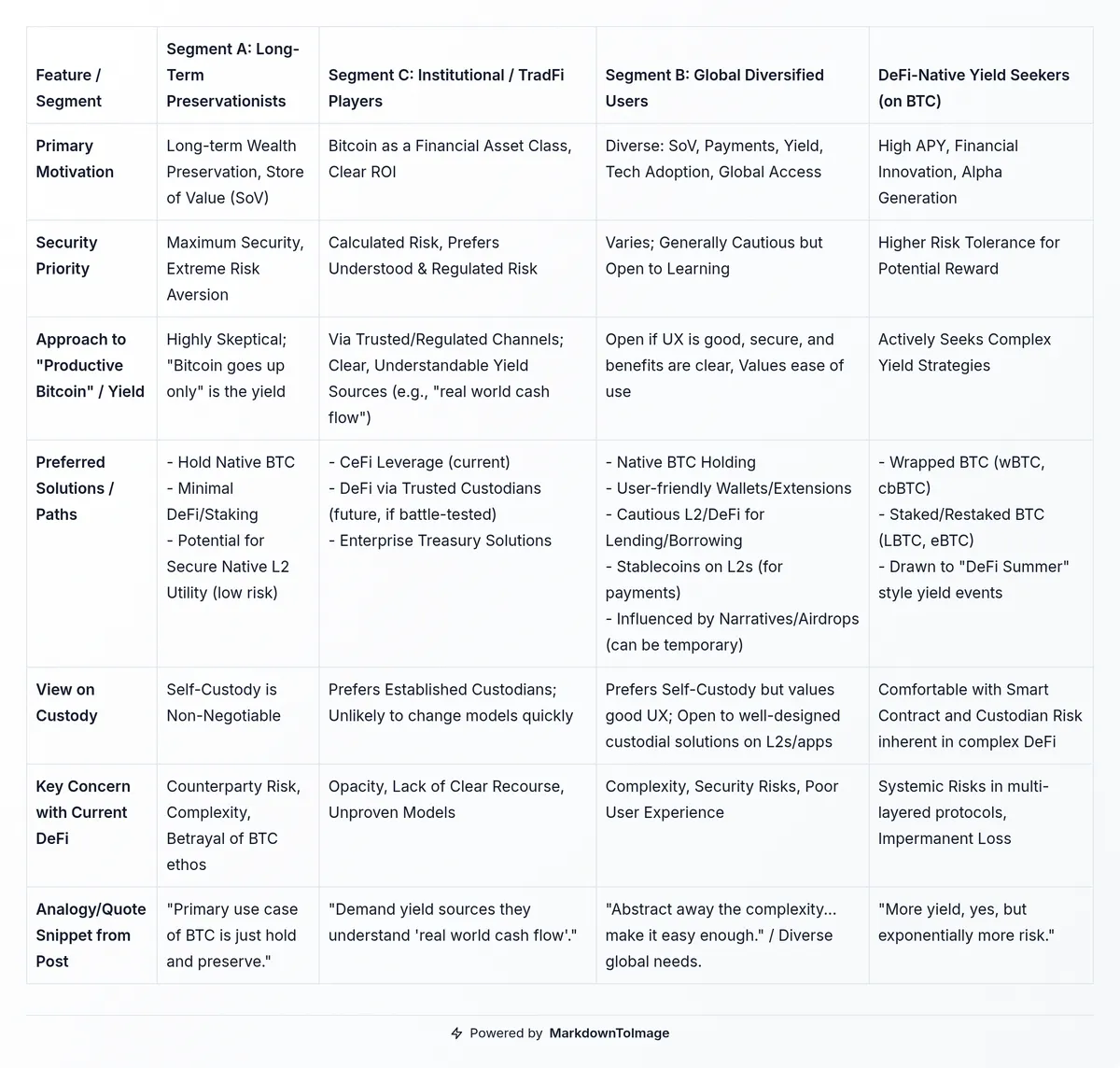
- Segment A: Long-Term Preservationists: This includes Bitcoin Whales and early adopters holding significant sums. Their operational code rests on three pillars:
- Preserve Above All: Wealth preservation is the primary goal, not yield farming. As one panelist stated, "the primary use case of BTC is just hold and preserve." Bitcoin is digital gold; many aim simply to "get rich" by holding.
- Security is Paramount: Scarred by past failures (Mt. Gox, Celsius, BlockFi), this group exhibits extreme risk aversion. Opaque yield sources are immediate red flags, understanding that recovery from DeFi hacks is unlikely.
- Self-Custody is Non-Negotiable: Control over private keys is paramount. "Custody of the asset is still super important... I'm not going to give up custody." Even high potential yields see minimal allocation due to the belief that holding native BTC is the ultimate long-term strategy.
- Segment B: Global Diversified Users: This "organic" user base spans the globe, from developing regions to financial centers. Their motivations for holding Bitcoin vary dramatically – remittance, inflation hedge, accessible savings, speculation – and differ significantly from typical DeFi users on other chains like Solana. Their risk appetite can vary geographically (e.g., potentially higher interest in staking in parts of Asia vs. North America).
- Segment C: Institutional / TradFi Players: A newer force comprising hedge funds, asset managers, and corporate treasuries entering via ETFs or direct holdings. They view Bitcoin primarily as a volatile asset class for sophisticated financial strategies (hedging, arbitrage, yield extraction via familiar structures). They demand clear, understandable yield sources ("real world cash flow") and often rely on existing CeFi infrastructure (prime brokers, custodians), making transitions to self-custody DeFi solutions challenging.
This segmentation reveals differing demands and risk tolerances across the Bitcoin ecosystem.
(See Figure 1 for a detailed breakdown of these segments)
Figure 1: Illustrating the Diverse Bitcoin Holder Landscape and Their Approaches (Formal segment names applied)
The Challenge: Utility vs. Security, The Great Divide & Diverse Appetites
Here lies the central conflict. How do you offer yield without triggering the PTSD from Celsius and BlockFi, where opaque "yield" meant customer funds got rehypothecated and lost? How do you bridge the chasm between defi degens demanding 30% APY, TradFi demanding 8% with extreme clarity, and a significant portion of Bitcoiners who, as one panelist put it, have "absolutely no interest in staking or any sort of tech forward platform"?
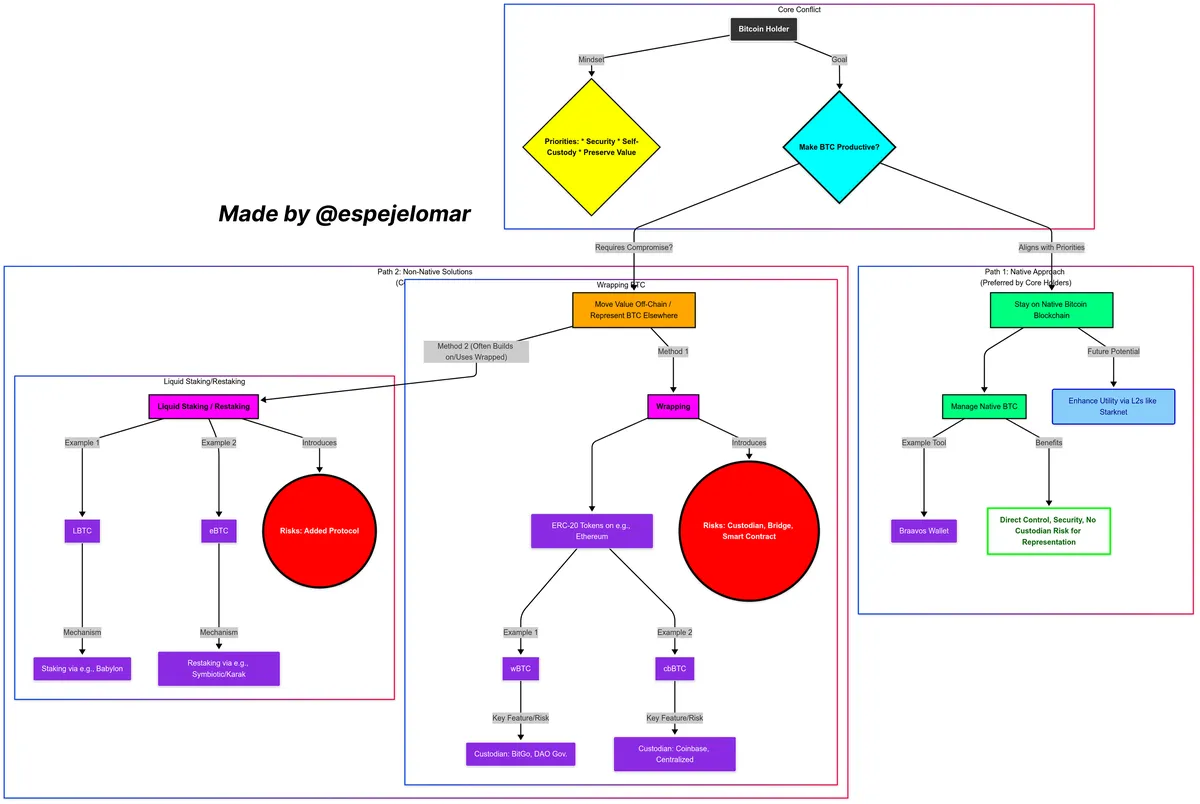
The flowchart below (Figure 2) visually summarizes this core conflict and the contrasting pathways Bitcoin holders face when considering how to make their BTC productive.
Figure 2: Flowchart illustrating the core conflict for Bitcoin holders seeking to make their BTC productive, contrasting native solutions with non-native approaches like wrapping and staking, highlighting key trade-offs. (Image credit: @espejelomar)
The Reality: Mismatch Between Solutions and Demand
The TOKEN2049 "BTC Summit" often emphasized non-native solutions: Wrapping, Staking, Restaking. Yet, the market data paints a stark picture.
- Scale Mismatch: Bitcoin's market capitalization hovers around $2.0 trillion (as of May 2025). In contrast, Bitcoin-specific DeFi TVL remains incredibly small. For instance, Rootstock, a prominent Bitcoin sidechain, reported TVL declining to roughly $180 million in Q1 2025 – less than 0.01% of Bitcoin's market cap. Even generous estimates place total Bitcoin DeFi TVL as "peanuts," as one panelist described it.
- Volume Disparity: DeFi's share of total Bitcoin trading volume is estimated by some panelists at a mere 0.1%, dwarfed by centralized exchanges handling the vast majority of activity (often cited as >95% of total crypto volume historically).
- Misaligned Incentives: The proposed solutions often force users onto different chains, introducing unacceptable custodial risks (@BitGo, @coinbase), bridge risks, and smart contract vulnerabilities for the core holder segments (A & B). Many users aren't chasing abstract DeFi yields but seek practical utility, like using native BTC as collateral for loans (often paying high single-digit or low double-digit APRs, e.g., 8-12%+, in CeFi) to access liquidity without triggering capital gains taxes. Current complex DeFi largely fails to meet this need securely and reliably.
The "ETH is the testnet" philosophy proves flawed here; Bitcoin's user base demands different solutions. The irony is a "BTC Summit" sometimes sidelining native potential for solutions tailored to a niche, risk-tolerant audience.
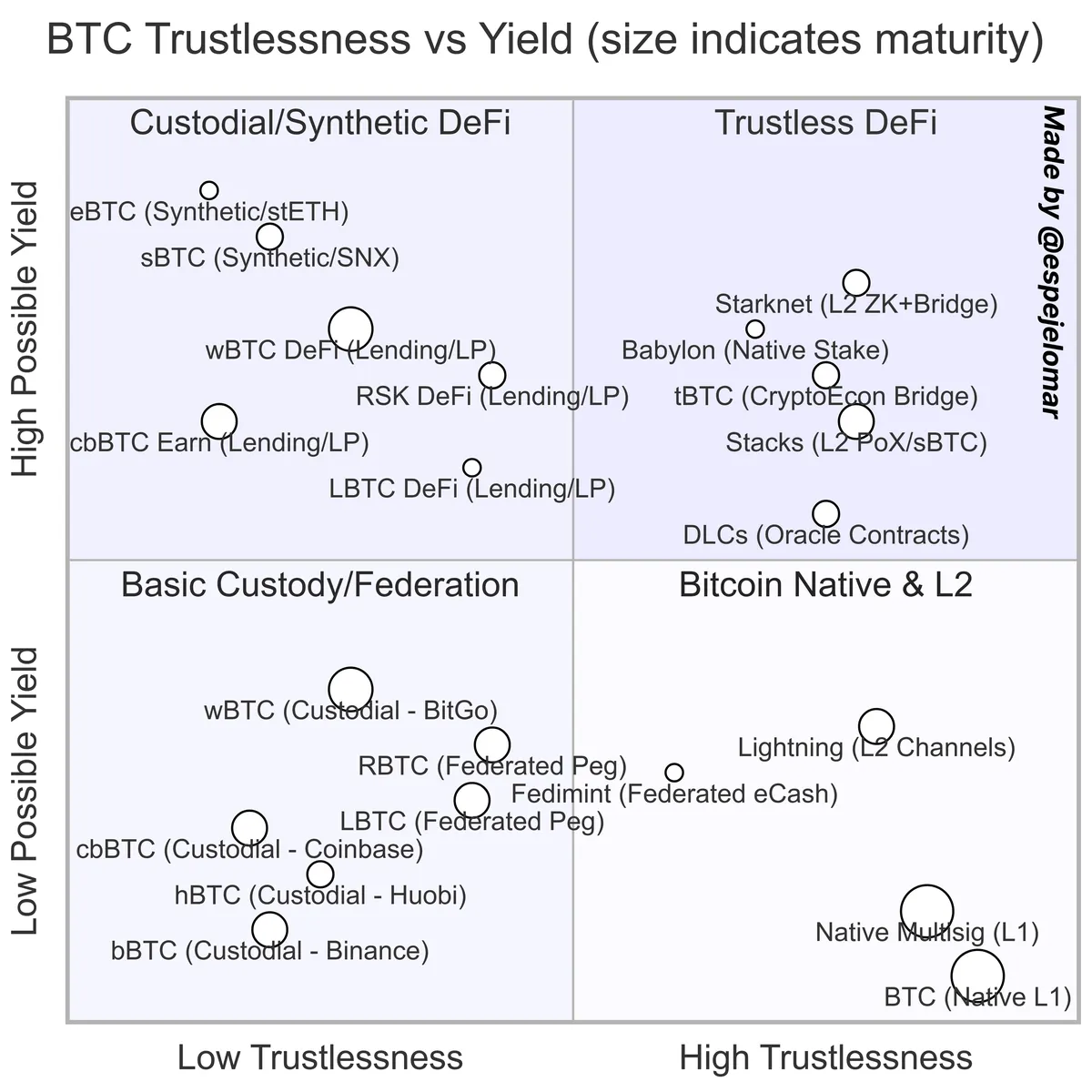
(Figure 3 maps the current solution landscape)
Figure 3: BTC Trustlessness vs. Yield, mapping various solutions from custodial/synthetic DeFi to trustless DeFi and native L2s. The size of the circles indicates perceived maturity. (Image credit: @espejelomar)
In the first half of the post, we established the core Bitcoin holder's mindset: prioritizing security, self-custody, and long-term value preservation above all else. This makes them naturally skeptical of solutions that introduce new risks or require trusting intermediaries. Now, let's look at the types of solutions discussed at TOKEN2049 for making Bitcoin "productive" and why they might not appeal to this core group, or even the broader, diverse Bitcoin retail segment, unlike native approaches.
Wrapping: The Siren Song of Ethereum
The dominant play: Drag Bitcoin onto Ethereum via wrapping. The lure? Access to DeFi’s ecosystem. The reality? A fundamental betrayal of Bitcoin principles for many, and a solution seeking a problem for others. This complexity is anathema to the risk-averse majority (Segments A & B).
a) wBTC: The established player. Relies on @BitGo custody. Translation: Centralized counterparty risk. One hack, one failure, and the peg breaks. This isn't trustless; it's outsourced trust. Panelists reminded us that wBTC’s TVL initially skyrocketed during the "DeFi Summer" when people could use it as LP to get more yield, indicating it was a specific event and yield chase that drove adoption, not a fundamental desire from core Bitcoiners to wrap their BTC.
b) cbBTC: Coinbase's version. Easier UX? Sure. But at the cost of total centralization. @coinbase holds the keys, the coins, the power. It’s TradFi masquerading as DeFi. For sovereignty-focused holders, entrusting billions to @BitGo or @coinbase isn't just risky; it's ideologically bankrupt.
Other variants exist (like tBTC or BTC.b), but the original sin persists: representing Bitcoin via IOUs on less secure chains, often dependent on custodians. It's not Bitcoin.
Adding Layers: The DeFi House of Cards
Wrapping wasn't enough? Enter the multi-layered complexity of staking and restaking. More yield, yes, but exponentially more risk, and often driven by temporary incentives like airdrops.
a) Liquid Staking (LBTC): Represents BTC supposedly earning yield via protocols like @babylonlabs_io. Now you trust the wrapper (@Lombard_Finance), the token's integrity, and the staking protocol's security/performance. Each layer multiplies the attack surface. Events like Babylon's airdrop saw massive inflows, as noted by panelists, but also significant outflows right after, once the low sustainable APY (1-2%) became clear, highlighting that current iterations are more about farming temporary incentives than sustainable yield for BTC.
b) Liquid Restaking (eBTC): Complexity squared via @ether_fi. Earn yield from base staking plus securing other networks via @symbioticfi or @Karak_Network. Trust the issuer. Trust the restaking platforms. Trust the other networks. Potential yield? Maybe. But it's yield buried under an avalanche of smart contract risks, slashing penalties, and operational dependencies. As one panelist admitted about DeFi hacks, "you're not getting your money back in most cases." This isn't a yield strategy; it's an invitation to systemic failure for the risk-averse.
The Native Sanctuary: Security Through Simplicity
Contrast the above with managing native Bitcoin:
- Direct Control: Your keys, your coins. No intermediaries.
- No Custodial Risk: Eliminates the single biggest fear.
- No Bridge Risk: Asset remains on the native, most secure chain.
- No Layered Protocol Risk: Security relies on the Bitcoin network itself.
This aligns with the principles of the largest holder segments and provides a trustworthy foundation for utility.
The Path Forward: Real Utility for Native Bitcoin
Focus must shift towards building value on or interacting directly with native Bitcoin, without forcing users into insecure paradigms.
- Leverage Native Assets: Technologies like Layer 2s or bridges designed for native asset interaction (e.g., @starknet's potential) can add utility (smart contracts, speed) without compromising core principles.
- Onboard New Capital: The ecosystem needs applications that attract net new funds, not just reshuffle existing capital. This requires abstracting complexity and focusing on user needs.
- Prioritize Secure Lending/Collateralization: While BTC payments face headwinds from stablecoins, lending against native BTC is a powerful use case. It allows holders (Segments A, B, and even C via custodians) to access liquidity tax-efficiently without selling. Building robust, secure, transparent, and unbreakable platforms for this is paramount.
Conclusion: Build For Bitcoin, Not DeFi Clones
Wrapped/staked solutions serve a niche DeFi audience, not the broader Bitcoin market holding ~$2 trillion in assets. The reliance on custodians, complex layers, and associated risks are deal-breakers for the majority.
Strategic Imperatives:
- Prioritize Native & Real Utility: Develop secure use cases on Bitcoin or interacting with native BTC (e.g., L2s). Focus on onboarding new capital via "apps people love," especially secure lending.
- Demand Transparency & Security: Any yield source must be clear, understandable, sustainable, and secure. No more black boxes. DeFi on Bitcoin must become "better, safer, more secure."
- Acknowledge Segment Needs: Build first for the largest, most risk-averse segments (Preservationists, Global Users), prioritizing simplicity and security. Make it "convenient and easy."
- Leverage the Collateral Use Case: Recognize tax-efficient borrowing against BTC as a prime, tangible need for long-term holders. Build secure native lending markets.
- Facilitate Institutional Access (Pragmatically): Understand institutions (Segment C) will likely access proven DeFi yields via trusted custodians initially. Secure native lending could pioneer this path.
The industry faces a choice: continue building complex, niche solutions, or create secure, native applications that meet the needs of the vast majority of Bitcoin holders and unlock trillions in capital on their own terms. Choose wisely.